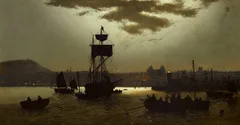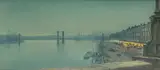
John Atkinson Grimshaw, Quai de Paris, Rouen

John Atkinson Grimshaw

British · 1836–1893 · Painter

Own a work by John Atkinson Grimshaw? Get a free auction estimate →

7lots offered2023–2026years recorded60%sold (3)$29.8kSign up free to seemedian price

1 work by John Atkinson Grimshaw with an auction history (offered more than once) →

Record prices

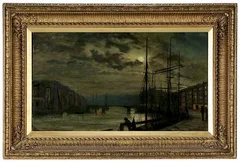
  1. John Atkinson Grimshaw, Glasgow Docks, circa 1880, oil on canvasGlasgow DocksBonhams · $203,700≈ £160,356≈ €186,556Sign up to see
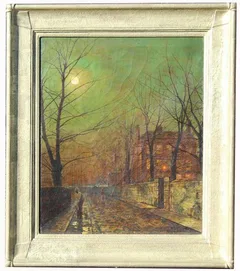
  2. John Atkinson Grimshaw, Moonlit Carriage by the River, Oil on Canvas. Probably Scarborough, showing the Grand Hotel at South Bay, with harbour to left. Atkinson Grimshaw was born in the North of England on 6 September 1836 at 9 Back Park Street, Leeds. Young Atkinson wanted to draw and to paint but his parents considered this time-wasting, foolish an... Click here to read more Atkinson Grimshaw was born in the North of England on 6 September 1836 at 9 Back Park Street, Leeds. Young Atkinson wanted to draw and to paint but his parents considered this time-wasting, foolish and unproductive. So, in 1852 Grimshaw was compelled to join the Northern Railway as a clerk, but he managed to practice the art of painting in his spare time. By the mid-1850s, the most progressive art in England was the Pre-Raphaelite style, with its emphasis on truth to nature, and Grimshaw’s early works painted birds’ nests, moss-covered stones and picturesque landscapes. Then in 1858, Grimshaw married his cousin Fanny, which enabled him to leave the family home, abandon his railway job and embark on a career as an artist. Grimshaw rapidly developed his own style and technique during the 1860s. By 1870 he was able to convey a more atmospheric view of the world, where mood, poetry and even mystery took hold. He became the ‘painter of moonlight’, building up a band of wealthy northern collectors and finding the financial success he needed to support his growing family. He is also known to have depended on photographs, and he collected picture postcards of Lake District landscapes on which he based many works. Grimshaw achieved his own consistent views that stayed with him throughout his career, such as the moonlit suburban lane with a mysterious half-hidden house and the lone figure of a woman walking along the road. Increasingly, Grimshaw’s moonlit landscapes and cityscapes bathed his subjects in an evocative glow, with the drabness of urban scenes transformed by night-time light effects. The first dockside scenes were also produced at this time, with rainy streets, brightly lit shop windows and people passing by. Grimshaw painted these from different angles, repeating the subjects over almost twenty years to keep his wife and children supported. He collected antique furniture and blue and white China to adorn their home, Knostrop Hall, and apparently fell into debt after he took on a second rented home in the mid-1870s, the Castle by the Sea in Scarborough. In his later working life, Grimshaw’s moonlight illuminates the contemporary urban scene, which had changed so much in the previous half century. The docks of Glasgow and Liverpool, and the fishing ports of Whitby, Hull, and Scarborough, presented many possibilities for light effects on water. The realities of modern urban life appealed to him, but there was a general unease in society about social change. It was perhaps a sense of regret for the past that inspired Grimshaw to imbue his paintings with a sense of nostalgia. Indeed, following the artistic success of the 1870s, Grimshaw’s career at times floundered. He tried to make a mark on the London art scene, renting a studio in Chelsea and taking with him his model Agnes Leefe, who was part of the household, and perhaps his lover. Grimshaw’s family history was to become profoundly sad. In the first five years of marriage, he and his wife had four babies who were stillborn or died shortly after birth, and one daughter, Clara, who lived to be twelve. Altogether, they had 16 children, only six of whom – Arthur, Enid, Louis, Wilfred and twins Lancelot and Elaine – survived into adult life. Here, already, we can connect a feeling with the artist who created and dated the unique painting we are now looking at; signed here ‘Atkinson Grimshaw 1892’ and created so very close to the end of his life. This work does not have an attached title, but it is not impossible to find a sense of place. Grimshaw painted many different subjects, often repeating them with the need to make money from sales. For me, examining this work, I find myself in places that look familiar to me from his other works. For instance, Grimshaw painted much of Liverpool Docks from Wapping, and this is what comes to my mind. The artist, from an early stage, preferred to create a winter evening, with lights on the right to the well-lit shops, water to the left, and the travelling horse traps in-between. The evening light is here in our painting, but the gloom is made greater than the light. There is a slight emptiness of the colours, and the lines are thinly drawn; the moon is there but half-hidden. Lighting from the few shops, the tall windows, creates Grimshaw’s much loved beam of colour. The figure of a man walks into the glow, far behind him there is a woman on her own, gazing through the shop window. Light reflects the feet of the horse-riding traveller, whilst the tall light standing beside the water gleams with a whiteness to match the moon. There is a sense of the delicate thinness of dark colours on Grimshaw’s painting, a time that was very near to the end of his life. At the same time, Grimshaw produced other works that displayed those pale effects of night-time light, with titles such as October Gold, 1893, Sand, Sea, Sky: A Summer Fantasy, 1892, and Snow and Mist: Caprice in Yellow Mirror, c. 1892. The canvases he worked on in his last days were smaller scale, with a lessening of artistic output but with his skills still there. The works were simplified with a lighter tonality and new, pale colour harmonies, especially with his scenes of snow and mist. When painting, Grimshaw was perhaps always thinking of the importance of nature alone. The late Alexander Robertson, a well-known author of Atkinson Grimshaw, wrote clearly about Grimshaw’s achievements: “The appeal of Grimshaw’s paintings lies in their apparent luminosity attained by seamless means… his surfaces seem enveloped by a misty atmosphere. This in turn created the mood of many paintings where a sense of loneliness and isolation are apparent, a feeling commented upon by writers when considering life in the cities. But perhaps most appealing to the modern audience is Grimshaw’s depiction of a Victorian world of suburban lanes with half-hidden houses and city streets, docks and fishing ports flooded by moonlight, creating an atmosphere of poetic nostalgia which makes Grimshaw, at his best, unique.” Grimshaw’s daughter Elaine lived until 1971, into a modern age that came far beyond her beloved father. Elaine became a writer and wrote many recollections of her father and his art. The whole family were very close to Atkinson Grimshaw and struggled to accept the loss of him. Elaine wrote: “Even in the last months of his life, terminally ill with liver cancer, in his room he turned back to his moonlit wet lanes and streets, painting, painting, painting all day, pictures to sell now and after he was gone. This all happened when poor sick Pappa was painting his last pictures. But gradually he grew too weak to paint and laid brushes and Mahl-stick away, too tired to read, only just the strength left to crawl upstairs on his hands and knees, and Mamma helping him undress, and lie down on his bed. One night when Mamma was sitting quietly beside his bed, she heard him murmur “no sun - no moon - no stars!” Poor, poor, Pappa, saying good-bye to all the beauty he so loved!” Jane Sellars, 2026Moonlit Carriage by the RiverGormley's Art Auctions · €26,000≈ $29,804≈ £22,303Sign up to see
  3. John Atkinson Grimshaw, Landscape with a Winding River, 1868, Oil on boardLandscape with a Winding RiverSloans & Kenyon · $15,000≈ £11,604≈ €13,850Sign up to see

John Atkinson Grimshaw’s highest prices recorded at auction, ranked in US dollars at each sale-date exchange rate and shown in the currency of the sale (with the buyer’s premium where the house publishes it).

ArtSell has recorded 5 auction results for John Atkinson Grimshaw between 2023 and 2026, of which 3 sold (60%). A further 2 lots were offered at auction without a published result. Recorded sale prices range from $15kSign up free to see to $204kSign up free to see. The highest price recorded is $204kSign up free to see for Glasgow Docks at Bonhams in December 2023. The most common medium is oil paintings (5 lots). Most results come from Leonard Auction (2), Sloans & Kenyon (2) and Whyte's (2).

All filters
Longest side–Reset

9 results

Sign up free to see all prices. You’ve seen the free realized prices for this month. Artist, title, date, house, medium, size and estimates stay visible to everyone. Create a free account · Sign in
  1. John Atkinson Grimshaw, Moonlit Carriage by the River, Oil on Canvas. Probably Scarborough, showing the Grand Hotel at South Bay, with harbour to left. Atkinson Grimshaw was born in the North of England on 6 September 1836 at 9 Back Park Street, Leeds. Young Atkinson wanted to draw and to paint but his parents considered this time-wasting, foolish an... Click here to read more Atkinson Grimshaw was born in the North of England on 6 September 1836 at 9 Back Park Street, Leeds. Young Atkinson wanted to draw and to paint but his parents considered this time-wasting, foolish and unproductive. So, in 1852 Grimshaw was compelled to join the Northern Railway as a clerk, but he managed to practice the art of painting in his spare time. By the mid-1850s, the most progressive art in England was the Pre-Raphaelite style, with its emphasis on truth to nature, and Grimshaw’s early works painted birds’ nests, moss-covered stones and picturesque landscapes. Then in 1858, Grimshaw married his cousin Fanny, which enabled him to leave the family home, abandon his railway job and embark on a career as an artist. Grimshaw rapidly developed his own style and technique during the 1860s. By 1870 he was able to convey a more atmospheric view of the world, where mood, poetry and even mystery took hold. He became the ‘painter of moonlight’, building up a band of wealthy northern collectors and finding the financial success he needed to support his growing family. He is also known to have depended on photographs, and he collected picture postcards of Lake District landscapes on which he based many works. Grimshaw achieved his own consistent views that stayed with him throughout his career, such as the moonlit suburban lane with a mysterious half-hidden house and the lone figure of a woman walking along the road. Increasingly, Grimshaw’s moonlit landscapes and cityscapes bathed his subjects in an evocative glow, with the drabness of urban scenes transformed by night-time light effects. The first dockside scenes were also produced at this time, with rainy streets, brightly lit shop windows and people passing by. Grimshaw painted these from different angles, repeating the subjects over almost twenty years to keep his wife and children supported. He collected antique furniture and blue and white China to adorn their home, Knostrop Hall, and apparently fell into debt after he took on a second rented home in the mid-1870s, the Castle by the Sea in Scarborough. In his later working life, Grimshaw’s moonlight illuminates the contemporary urban scene, which had changed so much in the previous half century. The docks of Glasgow and Liverpool, and the fishing ports of Whitby, Hull, and Scarborough, presented many possibilities for light effects on water. The realities of modern urban life appealed to him, but there was a general unease in society about social change. It was perhaps a sense of regret for the past that inspired Grimshaw to imbue his paintings with a sense of nostalgia. Indeed, following the artistic success of the 1870s, Grimshaw’s career at times floundered. He tried to make a mark on the London art scene, renting a studio in Chelsea and taking with him his model Agnes Leefe, who was part of the household, and perhaps his lover. Grimshaw’s family history was to become profoundly sad. In the first five years of marriage, he and his wife had four babies who were stillborn or died shortly after birth, and one daughter, Clara, who lived to be twelve. Altogether, they had 16 children, only six of whom – Arthur, Enid, Louis, Wilfred and twins Lancelot and Elaine – survived into adult life. Here, already, we can connect a feeling with the artist who created and dated the unique painting we are now looking at; signed here ‘Atkinson Grimshaw 1892’ and created so very close to the end of his life. This work does not have an attached title, but it is not impossible to find a sense of place. Grimshaw painted many different subjects, often repeating them with the need to make money from sales. For me, examining this work, I find myself in places that look familiar to me from his other works. For instance, Grimshaw painted much of Liverpool Docks from Wapping, and this is what comes to my mind. The artist, from an early stage, preferred to create a winter evening, with lights on the right to the well-lit shops, water to the left, and the travelling horse traps in-between. The evening light is here in our painting, but the gloom is made greater than the light. There is a slight emptiness of the colours, and the lines are thinly drawn; the moon is there but half-hidden. Lighting from the few shops, the tall windows, creates Grimshaw’s much loved beam of colour. The figure of a man walks into the glow, far behind him there is a woman on her own, gazing through the shop window. Light reflects the feet of the horse-riding traveller, whilst the tall light standing beside the water gleams with a whiteness to match the moon. There is a sense of the delicate thinness of dark colours on Grimshaw’s painting, a time that was very near to the end of his life. At the same time, Grimshaw produced other works that displayed those pale effects of night-time light, with titles such as October Gold, 1893, Sand, Sea, Sky: A Summer Fantasy, 1892, and Snow and Mist: Caprice in Yellow Mirror, c. 1892. The canvases he worked on in his last days were smaller scale, with a lessening of artistic output but with his skills still there. The works were simplified with a lighter tonality and new, pale colour harmonies, especially with his scenes of snow and mist. When painting, Grimshaw was perhaps always thinking of the importance of nature alone. The late Alexander Robertson, a well-known author of Atkinson Grimshaw, wrote clearly about Grimshaw’s achievements: “The appeal of Grimshaw’s paintings lies in their apparent luminosity attained by seamless means… his surfaces seem enveloped by a misty atmosphere. This in turn created the mood of many paintings where a sense of loneliness and isolation are apparent, a feeling commented upon by writers when considering life in the cities. But perhaps most appealing to the modern audience is Grimshaw’s depiction of a Victorian world of suburban lanes with half-hidden houses and city streets, docks and fishing ports flooded by moonlight, creating an atmosphere of poetic nostalgia which makes Grimshaw, at his best, unique.” Grimshaw’s daughter Elaine lived until 1971, into a modern age that came far beyond her beloved father. Elaine became a writer and wrote many recollections of her father and his art. The whole family were very close to Atkinson Grimshaw and struggled to accept the loss of him. Elaine wrote: “Even in the last months of his life, terminally ill with liver cancer, in his room he turned back to his moonlit wet lanes and streets, painting, painting, painting all day, pictures to sell now and after he was gone. This all happened when poor sick Pappa was painting his last pictures. But gradually he grew too weak to paint and laid brushes and Mahl-stick away, too tired to read, only just the strength left to crawl upstairs on his hands and knees, and Mamma helping him undress, and lie down on his bed. One night when Mamma was sitting quietly beside his bed, she heard him murmur “no sun - no moon - no stars!” Poor, poor, Pappa, saying good-bye to all the beauty he so loved!” Jane Sellars, 2026
    Moonlit Carriage by the River
    Oil · Canvas
    H 35cm x W 45cm
    Gormley's Art Auctions · · Lot 24
    €26,000≈ $29,804≈ £22,303HammerSign up free to seeView at Gormley's Art Auctions ↗
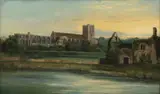
  2. John Atkinson Grimshaw, Christchurch Priory and Constable's House, Dorset, England, Oil on Canvas
    Christchurch Priory and Constable's House, Dorset, EnglandAttributed to the artist
    Oil · Canvas
    DuMouchelles · · Lot 4043
    $325≈ £244≈ €284HammerSign up free to seeEst. $250–450View at DuMouchelles ↗
  3. John Atkinson Grimshaw, Landscape with a Winding River, 1868, Oil on board
    Landscape with a Winding River, 1868
    Oil · Board
    15.75 x 20 in
    Sloans & Kenyon · · Lot 1243
    $15,000≈ £11,604≈ €13,850HammerSign up free to seeEst. $20,000–30,000View at Sloans & Kenyon ↗
  4. John Atkinson Grimshaw, Glasgow Docks, circa 1880, oil on canvas
    Glasgow Docks, circa 1880
    Oil · Canvas
    11 15/16 x 17 15/16 in (30.3 x 45.6 cm)
    Bonhams · · Lot 1
    $203,700≈ £160,356≈ €186,556Price realizedSign up free to seeEst. $120,000–180,000View at Bonhams ↗
  5. UntitledAttributed to the artist
    Oil · Canvas
    24 x 20 in
    Helmuth Stone Gallery · · Lot 444
    $4,410≈ £3,290≈ €3,932$3,500 + $910 premiumSign up free to seeEst. $5,000–7,000View at Helmuth Stone Gallery ↗
  6. Whitbey Harbor by Moonlight, 1882Manner of the artist
    Oil · Canvas
    18 x 30 in.
    Brunk Auctions · · Lot 1051
    $4,750≈ £3,658≈ €4,291HammerSign up free to seeEst. $2,000–3,000View at Brunk Auctions ↗
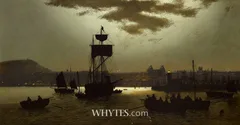
  7. SCARBOROUGH HARBOUR
    Oil · Board
    10 x 19in. (25.40 x 48.26cm)
    Whyte's · · Lot 79
    Unsold / did not meet reserveEst. €50,000–70,000View at Whyte's ↗
  8. SCARBOROUGH HARBOUR
    Oil · Board
    10 x 19in. (25.40 x 48.26cm)
    Whyte's · · Lot 9
    Unsold / did not meet reserveEst. €80,000–120,000View at Whyte's ↗
  9. John Atkinson Grimshaw, October'S Full Moon on Village Street, Oil on canvas
    October'S Full Moon on Village StreetAttributed to the artist
    Oil · Canvas
    30 in. x 25 in.
    Sloans & Kenyon · · Lot 1042
    Unsold / did not meet reserveEst. $2,500–3,500View at Sloans & Kenyon ↗
Also offered, result not published (2)

Lots by John Atkinson Grimshaw that were offered at auction where the house did not publish whether they sold. Not counted in any statistics.

John Atkinson Grimshaw paintings (5)John Atkinson Grimshaw oil paintings (5)

John Atkinson Grimshaw: quick facts

What is the highest price paid for a work by John Atkinson Grimshaw at auction?

$203,700Sign up free to see, for Glasgow Docks at Bonhams (December 2023) — the highest price in ArtSell’s records.

What is a typical auction price for John Atkinson Grimshaw?

The median sale price is $29.8kSign up free to see across 3 priced sales. Prices vary by medium, size and date — see the price chart & statistics.

How many works by John Atkinson Grimshaw have sold at auction?

3 of 5 recorded lots sold between 2023 and 2026. 2 further lots were offered with no published result and are not counted.

Which auction houses sell John Atkinson Grimshaw?

Leonard Auction, Sloans & Kenyon and Whyte's account for the most recorded results. Leonard Auction · Sloans & Kenyon · Whyte's

About John Atkinson Grimshaw

In museum collections

  • John Atkinson Grimshaw, Quai de Paris, RouenQuai de Paris, Rouen, 1893
    Wikimedia Commons · Public domain
  • John Atkinson Grimshaw, Old English House by MoonlightOld English House by Moonlight
    Museum of Fine Arts Boston · Public domain
  • John Atkinson Grimshaw, A House in a ClearingA House in a Clearing, 1870
    Minneapolis Institute of Art · Public domain
  • John Atkinson Grimshaw, A Moonlit EveningA Moonlit Evening, 1880
    Thyssen-Bornemisza Museum · Public domain

All 9 open-access museum images →

Related artists — British, born 1811–1861